
German Schengen Visa Denial & Appeals
- Most travelers from third countries need a Schengen visa to visit Germany, which allows them to travel within all 29 Schengen states.
- Various proofs and documents are required to obtain a German Schengen visa, which differs depending on the trip’s purpose and the visa type (C visa for short stays up to 90 days, D visa for long-term stays).
- If these documents are not fully available, there are security concerns, or there are doubts about the applicant’s willingness to return, the visa may be refused.
- If a Schengen visa is rejected, you have 2 options: file a lawsuit with the relevant Administrative Court or submit a new visa application with improved documents.
- The appeal process involves submitting a written statement explaining why you believe the visa should be granted and any additional supporting documents. The embassy or court will then review your appeal and decide.
- A new visa application may be faster if rejection is due to missing documents.
Visa obligation and visa rejection
Travelers from most third countries require a Schengen visa to enter Germany, which entitles them to travel freely in all 29 Schengen countries. Understanding the visa requirements is crucial for a successful application.
When issuing a visa, a distinction is made between C visas for short-term stays of up to 90 days and D visas (national visas) for a longer stay, such as studying, working, seeking employment, or family reunification. Travelers require certain proof and documents for each type of visa.
Germany has signed the Schengen agreement like most other EU countries except Ireland and Cyprus. Together with the non-EU countries Iceland, Norway, Switzerland, and Liechtenstein, they form the Schengen area. There are usually no internal border controls between the Schengen countries. To enter the Schengen area, travelers from most third countries need a Schengen visa issued according to uniform criteria. The embassy of the country through which you enter the Schengen area or are expected to spend most of your time is responsible for issuing visas. You can apply for a German Schengen visa at the German embassy in your home country or country of residence.
However, travelers from third countries who require a visa have no vested right to be issued a Schengen visa. For example, in 2022, around 13% of all applications for a German visa were rejected.
In this case, you will get a rejection letter from the responsible German Embassy stating the reasons for the rejection.
Persons affected by a visa rejection have the right to appeal or to file a court action against this decision.
Reasons for a German Visa Rejection
The reasons for a visa rejection can vary greatly. A visa rejection due to missing documents or procedural errors is easy to rectify. It is much more serious if the embassy – possibly in coordination with other German or European authorities – rejects a German visa because of security concerns or not fulfilled admission criteria.
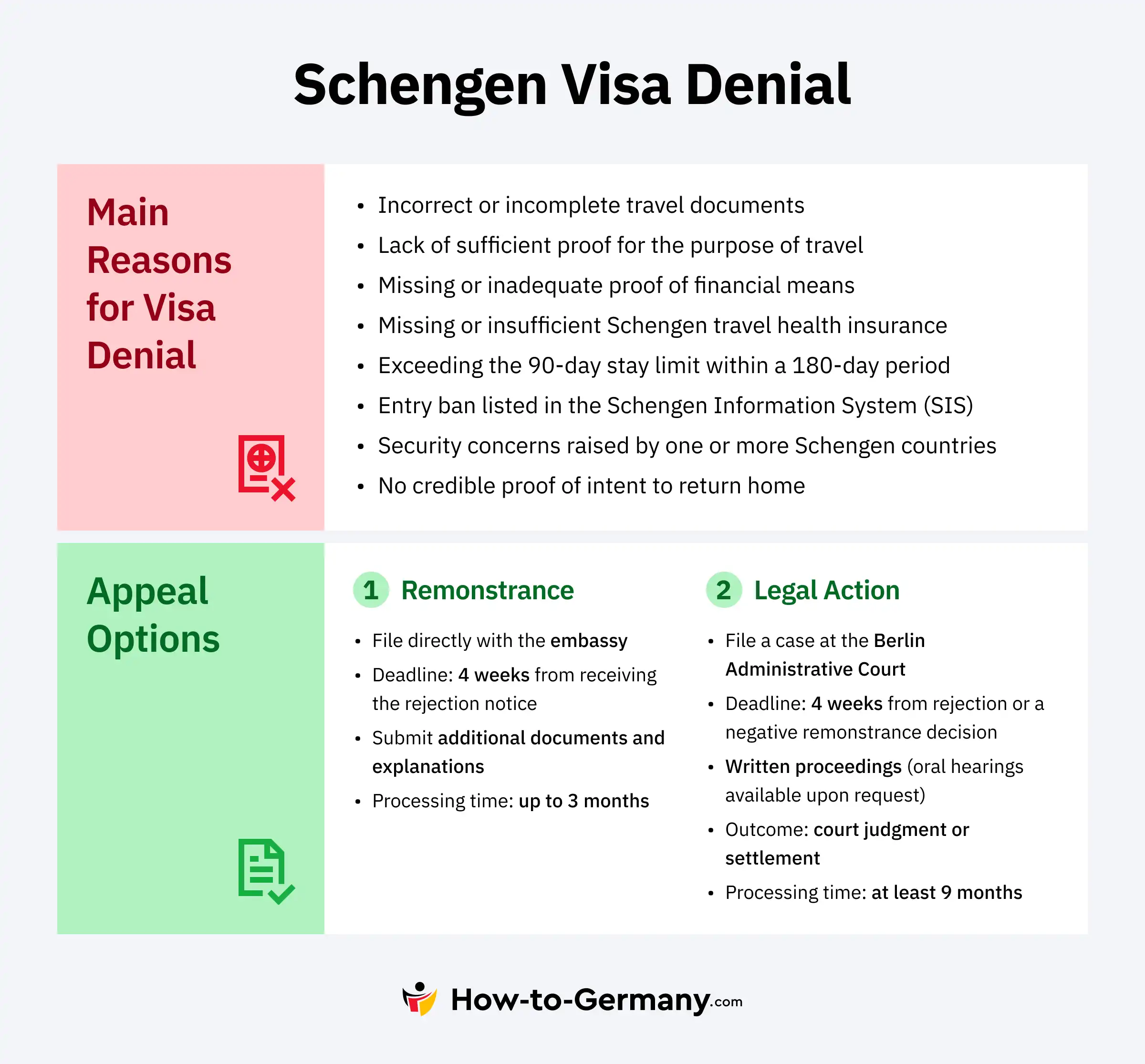
The main reasons for a visa rejection are as follows:
Forged, falsified, or non-accepted travel documents
Of course, a valid passport is required for a visa to be issued.
The visa application will be rejected if the embassy concludes that a passport is forged or falsified.
Passport photos submitted with the visa application must meet the biometric requirements of the German authorities. These requirements typically include specific dimensions for the photo, a neutral facial expression, and a plain background.
There may also be problems with granting visas in a few countries whose passports do not meet the technical standards of the Schengen countries regarding biometrics and machine readability. Some countries’ passports may not be recognized in the Schengen area or by individual Schengen countries.
Forgery of other documents also leads to visa rejection.
Missing documents
To receive a visa for Germany, you must provide all the necessary documents. If documents are missing, your visa may be rejected. Additionally, you must submit a visa application form and pass a visa interview at the German Embassy.
Difficulties in obtaining a visa typically arise in the following situations, for example:
Insufficient evidence of the purpose of travel
Applicants must provide appropriate documentation to support their travel reasons when applying for a German visa. For a student visa, this might include a letter of admission from a German university. A work visa might require a job offer from a German employer and proof of professional qualifications. German embassies require specific documents for different types of visas and travel reasons.
For example, international students can apply for a student application visa or a regular German student visa. However, a student visa will only be granted if the student is officially admitted to a German university. Proof of contact with universities for orientation or admission to a study preparation program is sufficient for a student applicant.
Reasons for refusal due to insufficient evidence of the purpose of the trip include, for example:
- Documents that do not clearly indicate the reason for the stay
- When visiting family members in Germany, family ties are not credibly demonstrated.
- No proof of study or employment in the home country of the visa applicant
- The educational institution or employer has not issued an official letter of leave, or the dates on the document do not match the desired travel dates.
- A previous German visa was not used for Germany.
- Flight and hotel bookings submitted with the visa application have been canceled.
- For international students and job-seekers: Proof of previous educational qualifications and sufficient language proficiency is missing. In most cases, German language skills must also be proven to issue visas for family reunification.
Missing or insufficient proof of financial means
To be issued a Schengen visa, applicants must prove they can independently finance their living expenses during their entire stay in Germany and the Schengen area. There are various options for doing so, for example:
- Proof of own financial means through salary statements or bank statements
- A written declaration from family members – for example, parents – that they will cover the costs of the stay (including proof of the available financial resources)
- A declaration of commitment from a sponsor residing in Germany. Sponsors can be family members, friends, companies, or public institutions. The declaration must be submitted to the relevant immigration office, which will review it.
- International students can open a German blocked account with a deposit of at least €11,904 for a full year. €992 can be paid out to a German current account per month. A pro rata deposit is possible for shorter study visits.
The visa application will be rejected if none of these proofs are provided or the German Embassy does not accept the documents submitted.
No proof of health insurance
A health insurance policy with coverage of at least €30,000 is required for a German visa. It must be valid for the entire duration of the planned trip, and, in addition to outpatient and inpatient emergency treatment, it must also ensure medically necessary return transport to the home country and repatriation in the event of death. The insurer must be based in Germany or another European country.
International students can usually also obtain a German visa with travel health insurance that meets the requirements of the German authorities. However, providers often only offer their travel insurance for a limited period of time. An alternative to this can be expat insurance, which is offered by insurers such as Feather or Getsafe for a stay of up to 5 years. Students studying full-time at a German university need regular German health insurance at the latest after entering Germany.
C-Visa: Non-compliance with the permissible length of stay
A C visa entitles you to stay in the Schengen Area for a maximum of 90 days within a 180-day period. Subsequently, you can only apply for a new visa after the 180-day period has expired.
Security concerns
Germany or another Schengen country has security concerns about a visa applicant’s entry. These may include assumed threats to internal security, public order, international relations, or public health (for example, for entries from epidemic or endemic areas).
A German visa is usually impossible if a visa applicant has been reported to the Schengen Information System (SIS). Those affected can apply to the Federal Criminal Police Office in Wiesbaden for self-disclosure and, if necessary, to the office that initiated the entry to request deletion or a time limit.
Lack of willingness to return
One of the most common reasons for refusing visitor visas for the Schengen area is the assumption that the applicant is unwilling to return to his home country.
Visa applicants must convince the embassy that they are economically and socially rooted in their country. Evidence of this includes, for example:
- Family ties (spouse, children, parents, etc.)
- Care of relatives
- A verifiable and adequate occupation
- Property (real estate and other assets)
The economic circumstances play a central role in assessing the willingness to return. If the embassy has doubts, the visa will not be granted.
What to do after a German visa rejection
If your German visa application is rejected, you have two options: file a lawsuit with the Administrative Court in Berlin or submit a new visa application with improved documents.
Since July 2025, the remonstration procedure (appeal at the German embassy) has been abolished worldwide. Applicants can no longer request a review of their visa rejection through the embassy.
In many cases, submitting a new visa application is the faster and more practical option—especially if the rejection was due to missing documents or insufficient evidence.
Submitting a new visa application
If your visa was rejected due to incomplete or unclear documentation, reapplying is often the most effective solution.
Before submitting a new application, you should:
- Carefully review the reasons for the visa rejection
- Provide all missing or corrected documents
- Strengthen proof of your travel purpose and financial means
- Submit additional evidence demonstrating your willingness to return to your home country
A new application can usually be processed faster than legal action and offers a higher chance of success if the issues are clearly resolved.
Filing a lawsuit with the Administrative Court in Berlin
Alternatively, you can challenge the visa rejection by filing a lawsuit with the Administrative Court in Berlin.
This option may be appropriate if:
- You believe the decision was legally incorrect
- You have already submitted all required documents
- The rejection is based on disputed facts or legal interpretation
Legal proceedings must typically be initiated within one month of receiving the rejection notice. Court proceedings can take several months and may involve legal costs.
Conclusion
Obtaining a German visa requires careful preparation and complete documentation. While a rejection can be frustrating, it is often possible to resolve the issue.
Since embassy appeals are no longer available, applicants must decide between reapplying with improved documents or taking legal action. In most cases, reapplying is faster and more practical, while court proceedings are reserved for complex or disputed cases.
Frequently Asked Questions
You can apply for a German visa no earlier than 6 months and no later than 15 days before the planned travel date. Outside these deadlines, the embassies will not accept your visa application. However, suppose you are applying for a German national visa (D visa) for a stay of 90 days. In that case, you should calculate processing times of up to 3 months and apply for your German visa as early as possible. In addition, it may take several weeks before you can attend the visa interview.
This depends on the reasons for the visa rejection. A new visa application is usually better if only important documents are missing. In this case, you have a good chance of getting the visa on your second attempt as soon as you have submitted the right documents. The visa application processing is almost always faster than a remonstrance procedure.
If the reasons for refusal are serious, including an assumed lack of willingness to return, you should choose remonstrance and, if necessary, a court complaint.
Yes. In such cases, the embassy may assume a lack of willingness to return and reject your visa application. In the case of serious violations, blocking periods of 1–3 years may apply, during which you cannot obtain a Schengen visa. Without a blocking period, you can try to clarify the reasons for a previous overstay with the German embassy and provide evidence of it — ideally, before you submit your visa application. Convincing evidence of your willingness to return or earlier trips in the Schengen area without violating the rules can also be important arguments for granting a new visa.
For rejecting a transit visa for a German airport or the airports of other Schengen countries apply the same reasons as for other visa denials. You can appeal against it or submit a new visa application with the right documents.